
This page collects the shipping container, pallet and trailer figures our calculators use, each with its source. A standard 20ft container holds about 33 m³ inside, a 40ft about 67–68 m³, a 40ft high cube about 76 m³ and a 45ft high cube about 86 m³. Carriers publish slightly different numbers for the same type of box, so always check the figures on your booking.
Hapag-Lloyd container pallet specifications for dry containers
| Type | Inside L × W × H (mm) | Door W × H (mm) | Volume | Tare | Max payload |
|---|---|---|---|---|---|
| 20ft standard | 5,900 × 2,352 × 2,395 | 2,340 × 2,292 | 33.2 m³ | 2,350 kg | 28,130 kg |
| 40ft standard | 12,032 × 2,352 × 2,395 | 2,340 × 2,292 | 67.7 m³ | 3,750 kg | 28,750 kg |
| 40ft high cube | 12,032 × 2,350 × 2,700 | 2,340 × 2,597 | 76.3 m³ | 3,900 kg | 28,600 kg |
| 45ft high cube | 13,556 × 2,352 × 2,700 | 2,340 × 2,597 | 86.0 m³ | 4,800 kg | 27,700 kg |
Source: Hapag-Lloyd container specifications. In feet and inches, a 20ft standard is about 19 ft 4 in long, 7 ft 9 in wide and 7 ft 10 in high inside (1,172 ft³); a 40ft high cube is about 8 ft 10 in high inside (2,694 ft³).
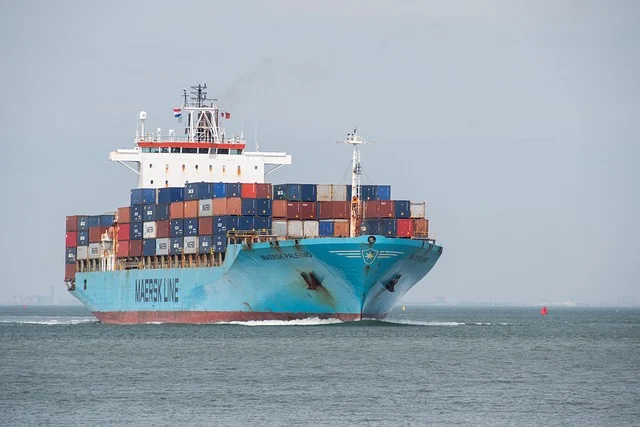
How carriers differ
| Type | Hapag-Lloyd | Maersk | CMA CGM | ONE |
|---|---|---|---|---|
| 20ft volume / tare | 33.2 m³ / 2,350 kg | 33 m³ / 2,280 kg | 33.2 m³ / 2,230 kg | 33.1 m³ / 2,150 kg |
| 40ft volume / tare | 67.7 m³ / 3,750 kg | 67 m³ / 3,700 kg | 67.8 m³ / 3,720 kg | 67.6 m³ / 3,640 kg |
| 40ft HC volume / tare | 76.3 m³ / 3,900 kg | 76 m³ / 3,880 kg | 76.4 m³ / 3,900 kg | 76.2 m³ / 3,700 kg |
| 45ft HC volume / tare | 86.0 m³ / 4,800 kg | 85 m³ / 4,900 kg | 86.0 m³ / 4,700 kg | 86.0 m³ / 4,650 kg |
Sources: CMA CGM containers, ONE dry containers and Maersk’s published equipment specifications. Maximum gross weight is 30,480 kg or 32,500 kg depending on the individual box, so payload can differ by about 2 tonnes for the same type.
Usable volume
You will rarely fill the full inside volume. Cartons leave gaps at the walls and roof, pallets add their own height, and the doors need clearance. Our calculators use 85% of the inside volume as a realistic planning figure: about 28 m³ in a 20ft, 58 m³ in a 40ft and 65 m³ in a 40ft high cube. Uniform cartons loaded by hand can do better; mixed or palletized cargo often does worse. The box fit calculator works out the real count for your carton size.
Reefer, open top and flat rack containers (Hapag-Lloyd)
| Type | Inside L × W × H (mm) | Volume | Max payload |
|---|---|---|---|
| 20ft reefer | 5,450 × 2,280 × 2,159 | 28.1 m³ | 29,140 kg |
| 40ft reefer high cube | 11,599 × 2,290 × 2,425 | 67.7 m³ | 29,580 kg |
| 20ft open top | 5,895 × 2,350 × 2,340 | 32.5 m³ | 30,050 kg |
| 40ft open top | 12,029 × 2,350 × 2,344 | 66.8 m³ | 28,450 kg |
| 20ft flat rack | 5,638 × 2,438 floor × 2,233 | – | 42,100 kg |
| 40ft flat rack high cube | 11,652 × 2,347 floor × 2,265 | – | 49,100 kg |
Standard pallet sizes
| Pallet | Size | Where it is used |
|---|---|---|
| EUR / EPAL 1 | 1,200 × 800 × 144 mm | Europe; safe working load 1,500 kg |
| EUR 2 / industrial | 1,200 × 1,000 mm | Europe and Asia |
| GMA | 48 × 40 in (1,219 × 1,016 mm) | United States and Canada |
| Square | 1,100 × 1,100 mm | Asia |
| Australian standard | 1,165 × 1,165 × 150 mm | Australia (not an ISO 6780 size) |
Sources: ISO 6780, EPAL Euro pallet, Loscam Australian pallet.
How many pallets fit (single layer)
| Pallet | 20ft | 40ft / 40ft HC | 53ft US trailer | 13.6 m EU trailer |
|---|---|---|---|---|
| EUR 1,200 × 800 | 11 | 23–25 | – | 33 |
| EUR 2 1,200 × 1,000 | 9 | 20–21 | – | 26 |
| GMA 48 × 40 in | 9 | 20–21 | 26 straight, 30 turned | 24 |
Counts are geometric maximums on the floor with about 50 mm total clearance, checked against published figures from iContainers, C.H. Robinson and BTA International. Stacking pallets two high doubles the count only if the cargo is stackable and the height and weight allow it. Try your own pallet in the pallet calculator.
Trucks and trailers
| Equipment | Inside size | Typical load limit |
|---|---|---|
| 53ft US dry van | 52 ft 4 in × about 98 in × 110 in (about 3,500 ft³) | 44,000–45,000 lb |
| EU curtainsider (tautliner) | 13.6 × 2.44–2.48 × 2.65–2.70 m | 24.5 t |
| EU mega trailer | 13.6 × 2.45 × 3.00 m | 24 t |
The US federal gross vehicle weight limit on the Interstate system is 80,000 lb (FHWA). In the EU the usual maximum is 40 tonnes, or 44 tonnes for intermodal transport of 40ft containers. European groupage is often priced per loading meter: LDM = length × width in meters ÷ 2.4, so a Euro pallet takes 0.4 LDM, and carriers commonly count 1,850 kg per LDM internationally (2,000 kg on Nordic and UK lanes).
Volume and weight conversions
| Conversion | Value |
|---|---|
| 1 m³ | 35.3147 ft³ = 61,023.7 in³ |
| 1 ft³ | 0.0283168 m³ |
| Air cargo (IATA 1:6000) | 1 m³ = 166.67 kg chargeable |
| Courier 1:5000 | 1 m³ = 200 kg chargeable |
| Courier 139 in³/lb | ≈ 5,022 cm³/kg |
| Sea freight W/M | 1 m³ = 1,000 kg (1 revenue ton) |
| 1 kg | 2.20462 lb |
Conversions follow NIST SP 811. For the full rules behind each figure, see our shipping guides or open the freight calculators.

How to Plan Your Load Using Specifications
Effective load planning uses container and pallet specifications to maximize space and stay within weight limits. First, gather precise dimensions and weights for all your cargo items. This includes length, width, height, and unit weight. Next, decide on the appropriate container or pallet type for your shipment. Consider the origin, destination, and handling requirements. Then, calculate the total volume and weight of your entire consignment. You must compare these totals against the chosen container's maximum payload and volume capacity. Always account for usable space, as containers are rarely filled to their theoretical maximum. This careful planning helps avoid costly last-minute adjustments.
- Measure all cargo items for length, width, height, and individual weight.
- Select a suitable container or pallet type based on your shipping needs.
- Calculate the total volume and total weight of your entire shipment.
- Compare your total cargo volume against the container's usable volume.
- Verify your total cargo weight against the container's maximum payload.
Common Mistakes in Payload Calculation
Several errors can lead to miscalculations of payload capacity. One common mistake is confusing gross weight with net weight. The payload figure refers only to the cargo's weight, not the container's tare weight. Another error is neglecting the weight of packaging materials. Pallets, crates, and dunnage add significant weight to the overall shipment. Sometimes, people use theoretical maximums instead of actual usable figures. For example, a container's listed volume is often higher than what can realistically be loaded. Always factor in clearances and irregular cargo shapes. Therefore, always re-check your arithmetic to ensure accuracy. Overlooking these details can lead to exceeding weight limits or underutilizing space.
Practical Tips for Optimal Loading
Maximize loading efficiency with key strategies. First, know internal dimensions of your chosen container. This includes door openings, often narrower than internal width. Second, consider goods’ stacking potential. Stackable items use vertical space effectively. Non-stackable items require more floor area. Third, plan your loading pattern beforehand. A good plan minimizes wasted space. It also prevents damage. Use dunnage and bracing for securing cargo. Fill small gaps with them. Finally, distribute weight evenly. This maintains balance during transit. These tips use container pallet specifications for safe, efficient transport.