
 By
A loading meter (LDM) is one linear meter of trailer floor length. It covers the standard 2.4-meter width in European road freight. Use our loading meter calculator with this formula: LDM = (length in meters × width in meters) ÷ 2.4. Also divide by the stacking factor for stackable goods.
Loading meter (LDM) calculator
Runs in your browser; nothing you enter is sent anywhere. Carrier figures differ, so confirm the final numbers with your forwarder. Whole shipment: all-in-one freight calculator →
What is a loading meter calculator in European road freight?
Davies Turner defines a loading meter this way: “A loading metre is a strip of trailer floor space running the full width of the trailer and one metre long.” A standard European curtain-side trailer measures 13.6 meters long. It is 2.45 meters wide internally. It also stands about 2.7 meters high. Carriers standardize the usable floor width to 2.4 meters for billing. So, a full trailer has a total capacity of 13.6 LDM.
Actual gross weight, cubic volume, and floor area constrain cargo capacity. For example, you cannot stack a pallet if it is fragile, tall, or uneven. This blocks all vertical trailer space directly above it. Therefore, a carrier cannot place another customer’s cargo on top of an unstackable pallet. Pricing by LDM ensures the freight quote reflects the actual floor length your cargo immobilizes. This is true regardless of whether the shipment is light or heavy. Use a loading meter calculator for accurate LDM pricing.
How to calculate loading meters step by step
You calculate loading meters by converting your cargo’s length and width. This converts it into linear meters. It uses a standard 2.4-meter wide trailer bed. Follow these steps to calculate LDM for your shipment:

- Measure cargo footprint: Measure the maximum length and width of the pallet or package in meters. This includes any protruding packaging or overhang.
- Calculate square meters: Multiply length by width to find the footprint area in square meters.
- Divide by trailer width (2.4 m): Divide the footprint area by 2.4 to determine the unstacked loading meters per unit.
- Apply stacking factor: Your units may stack safely. If so, divide the single-unit LDM by the number of units in a stack. For example, divide by 2 for double-stacked cargo.
- Multiply by total quantity: Multiply the final per-stack LDM by the total number of floor positions required.
The mathematical LDM formula
For non-stackable cargo, Davies Turner and Eurosender both publish the baseline formula:
LDM = (length in meters × width in meters) ÷ 2.4
When goods are stackable, divide by the stacking factor:
LDM = (length × width ÷ 2.4) ÷ number of pallets per stack
Do you have multiple identical cargo pieces? Then multiply the single-piece LDM. Also, use the total number of pallet floor spots needed.
| Footprint | Size (m) | Working | LDM per piece |
|---|---|---|---|
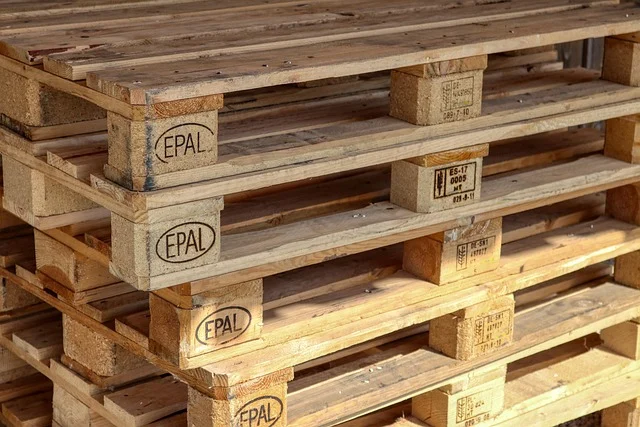
| Euro pallet (Euro 1) | 1.2 × 0.8 | 0.96 ÷ 2.4 | 0.4 |
| Industrial pallet (Euro 2) | 1.2 × 1.0 | 1.2 ÷ 2.4 | 0.5 |
| 1,100 × 1,100 mm pallet | 1.1 × 1.1 | 1.21 ÷ 2.4 | 0.504 |
| Crate | 3.0 × 1.5 | 4.5 ÷ 2.4 | 1.875 |
| Full trailer | 13.6 × 2.4 | 32.64 ÷ 2.4 | 13.6 |
How carriers convert loading meters to chargeable weight
Less-than-truckload (LTL) groupage carriers do not bill road freight on raw LDM alone. Instead, they convert loading meters into an equivalent volumetric mass, known as LDM weight, and bill on whichever is higher: the actual scale weight or the calculated LDM weight.

The conversion ratio represents the maximum average payload weight a full trailer can transport per linear meter. In European road freight, a full 13.6 m trailer typically carries up to 24,000–25,000 kg payload. Dividing 24,000 kg by 13.6 LDM gives approximately 1,765 kg per meter. Forwarders and transport associations standardize this factor between 1,500 kg and 2,000 kg per LDM depending on regional regulations and route conditions.
| Source | kg per LDM | Pallet place | Notes |
|---|---|---|---|
| DB Schenker Norway (Europe) | 1,850 | 740 kg = 0.4 LDM | 2,000 for the Nordic countries and domestic |
| DSV Sweden (international) | 1,850 | min 740 kg | 2,000 for Nordic countries, UK and Ireland; domestic 1,950 |
| Eurosender | 1,850 | n/a | broker |
| Davies Turner (UK) | 1,500–1,750 | n/a | “depending on carrier” |
A factor of 1,850 kg per LDM translates to 740 kg per standard Euro pallet place. This is because 0.4 LDM × 1,850 kg equals 740 kg. Road hauliers also apply cubic meter volume ratios. For example, they use 333 kg per m³ for international European groupage. Or, they use 250 kg per m³ in domestic networks. A loading meter calculator helps evaluate your shipment. You pay for whichever metric yields the highest billing weight.
Chargeable weight = max(actual gross weight, LDM × carrier LDM factor, volume m³ × CBM factor)
Worked calculation examples
Example 1: 6 Euro pallets, non-stackable, international Europe
Suppose you ship 6 non-stackable Euro pallets. Each pallet weighs 450 kg. You ship them from Belgium to Italy. Also, you use an international carrier. This carrier has an 1,850 kg/LDM conversion factor.
- LDM calculation: 6 pallets × 0.4 LDM = 2.4 LDM
- LDM weight: 2.4 LDM × 1,850 kg/LDM = 4,440 kg
- Actual weight: 6 pallets × 450 kg = 2,700 kg
- Chargeable weight: max(2,700, 4,440) = 4,440 kg
You cannot stack these pallets. Therefore, they reserve 2.4 meters of trailer floor space. This freight has low density for its floor occupancy. So, the carrier bills you for 4,440 kg. This is more than the physical 2,700 kg weight.
Example 2: 4 industrial pallets, stackable two high, to the UK
Suppose you ship 4 industrial pallets. Each one measures 1.2 × 1.0 m. Also, each pallet weighs 600 kg. The route has a 2,000 kg/LDM factor. The manufacturer certifies the goods are stackable two high.
- LDM per pallet: 1.2 × 1.0 ÷ 2.4 = 0.5 LDM
- Unstacked floor LDM: 4 pallets × 0.5 LDM = 2.0 LDM
- Stacked floor LDM: 2.0 LDM ÷ 2 = 1.0 LDM
- LDM weight: 1.0 LDM × 2,000 kg/LDM = 2,000 kg
- Actual weight: 4 pallets × 600 kg = 2,400 kg
- Chargeable weight: max(2,400, 2,000) = 2,400 kg
Making pallets stackable drops the floor space occupied. It goes from 2.0 LDM to 1.0 LDM. The actual weight of 2,400 kg now exceeds the 2,000 kg LDM weight. As a result, this saves 1,600 kg of chargeable weight compared to non-stackable handling. Carriers would have billed non-stackable handling at 4,000 kg.
Example 3: One oversized machinery crate
Consider an industrial machine crate measuring 3.0 m long by 1.5 m wide, weighing 1,900 kg, shipped via standard European groupage.
- LDM calculation: 3.0 m × 1.5 m ÷ 2.4 = 1.875 LDM
- LDM weight: 1.875 LDM × 1,850 kg/LDM = 3,468.75 kg
- Actual weight: 1,900 kg
- Chargeable weight: max(1,900, 3,468.75) = 3,468.75 kg
The crate’s width is only 1.5 m. This leaves 0.9 m of empty lateral floor space in the trailer. However, standard LDM formulas assume cargo takes up the full 2.4 m trailer width. If you cannot stow other cargo alongside the crate due to its irregular shape, the forwarder bills for the full 1.875 LDM footprint.
How the carrier LDM factor changes your freight invoice
The conversion factor applied by your transport company alters the billable weight for identical physical dimensions. Here is how standard carrier conversion rates bill the same 2.4 LDM shipment (from Example 1):

| kg per LDM | Calculation | Chargeable from LDM (kg) |
|---|---|---|
| 1,500 | 2.4 × 1,500 | 3,600 |
| 1,750 | 2.4 × 1,750 | 4,200 |
| 1,850 | 2.4 × 1,850 | 4,440 |
| 2,000 | 2.4 × 2,000 | 4,800 |
The difference between a 1,500 kg and 2,000 kg factor represents 1,200 kg of extra chargeable weight on the exact same load. When reviewing logistics proposals, evaluate both the weight conversion factor and the base rate per 100 kg.
Cargo overhang, odd shapes, and billing traps
Many people make a common error when calculating road freight costs. They fail to account for cargo overhang or irregular shapes. Carriers measure loading meters based on the shipment’s absolute maximum outer dimensions. This includes packaging, wrapping, or protruding parts.
For example, cartons may bulge 5 cm over each side of a standard Euro pallet (1.2 × 0.8 m). As a result, the effective footprint increases to 1.3 m × 0.9 m. You can recalculate this with the overhang to get:
Overhanging pallet LDM = (1.3 × 0.9) ÷ 2.4 = 0.4875 LDM
Instead of 0.4 LDM, a single overhanging pallet incurs 0.4875 LDM. On a 10-pallet consignment, this minor 5 cm overhang adds nearly 0.9 LDM of extra chargeable space. As a result, your billable weight increases by over 1,600 kg. If cargo has a slanted top, pointed peak, or fragile upper surface, carriers classify it as non-stackable. This forces LDM billing even if the pallet is under 1 meter high.
Mega trailers and double-decker trailer equipment
Trailer design impacts how carriers handle loading meters. This is especially true in specialized road transport:
- Standard curtain-siders (Tautliners): They offer internal clearance of ~2.7 m height. Also, they have 13.6 LDM capacity. Therefore, they are ideal for standard LTL and groupage.
- Mega trailers (Euro-megas): These trailers feature a lower floor bed. This provides 3.0 m of internal clearance height. They also maintain standard 13.6 LDM capacity (13.6 m length × 2.4 m width). Mega trailers allow high-volume cargo to stack higher. This does not increase LDM floor usage.
- Double-deck trailers (Doppelstock): These trailers have adjustable horizontal loading beams. These beams create a second floor level inside the trailer. This allows carriers to double-stack non-stackable Euro pallets. You can load up to 66 pallets instead of 33. This also avoids putting weight on lower goods. Carriers may offer discounted LDM rates on double-deck lanes. However, cargo must fit within individual deck height limits. These limits are typically under 1.2 m to 1.4 m per deck.
When is loading meter pricing NOT used?
Loading meter calculations are specific to European road freight groupage and LTL transport. You will not encounter LDM pricing in the following logistics modes:

- Full Truckload (FTL): When you book an entire trailer, pricing is a flat rate per vehicle. This covers the route up to the trailer’s legal weight limit.
- North American Road Freight: US and Canadian LTL carriers calculate rates differently. They use National Motor Freight Classification (NMFC) density classes. Also, they use linear foot rules or pallet position rates. They do not use LDM.
- Ocean Freight (LCL): Sea freight container consolidations calculate billing based on net cubic meters (CBM). Here, 1 CBM equals 1,000 kg, or 1 metric ton.
- Air Freight: Air cargo uses volumetric weight formulas based on gross dimensions in centimeters (Length × Width × Height in cm ÷ 6,000 or 5,000), representing 167 kg per m³.
- Parcel Networks: Express courier services price shipments on physical weight versus volumetric weight per parcel.
Practical steps to lower your loading meters
- Design goods for stackability: Use top-flat pallets. Sturdy outer corrugated boxes allow double-stacking. As a result, you cut your floor LDM in half.
- Eliminate overhang: Ensure cartons stay strictly within the pallet boundary. Align boxes flush with pallet edges to avoid incurring penalties.
- Match cargo to the correct pallet footprint: Choose a 1.2 × 0.8 m Euro pallet. This is 0.4 LDM. Alternatively, select a 1.2 × 1.0 m industrial pallet (0.5 LDM). Make your choice based on product dimensions. This avoids paying for excess wooden margin.
- Evaluate full truckload thresholds: Your total groupage LDM may reach 10 to 11 LDM. At this point, requesting an FTL quote is often cheaper. This is better than paying LTL LDM rates.
- Compare mode ratios: You may ship lightweight, bulky freight. If so, check CBM to kg rules. Decide whether road LTL, intermodal rail, or sea freight offers better chargeable weight benchmarks.
Frequently asked questions
How do you calculate a loading meter?
First, multiply the length by the width in meters. Then, divide by 2.4. Also, divide again by the stacking factor if you can stack the pallets.
How many loading meters is a Euro pallet?
0.4 LDM: 1.2 × 0.8 = 0.96 m², and 0.96 ÷ 2.4 = 0.4.
How many kg is one loading meter?
It depends on the carrier and lane. For example, DSV and DB Schenker use 1,850 kg internationally in Europe. They use 2,000 kg for Nordic lanes. For DSV, this also includes UK and Ireland lanes. Davies Turner, however, cites roughly 1,500–1,750 kg.
How many loading meters is a full trailer?
A standard 13.6 m European trailer is 13.6 LDM, which holds 33 Euro pallets in practice.
Is LDM used in the US?
US truckload and LTL pricing normally uses pallet positions, weight and NMFC freight class instead. LDM is a European road freight convention.
Related guides
- How Many Boxes Fit on a Pallet? (Pallet Loading Calculator)
- Freight Class Calculator and NMFC Density Chart (2025 Scale)
- How to Calculate Freight Density (PCF) for LTL
- US Truck Weight Limits: 80,000 lb and What It Means for Your Load
Sources and further reading
- Davies Turner: What Is a Loading Metre?: LDM definition and calculation.
- DB Schenker: Transport Conditions, Land (PDF): kg per loading meter and per pallet place.
- BTA International: Truck and Trailer Dimensions: EU trailer sizes, payloads and pallet spaces.