
 By
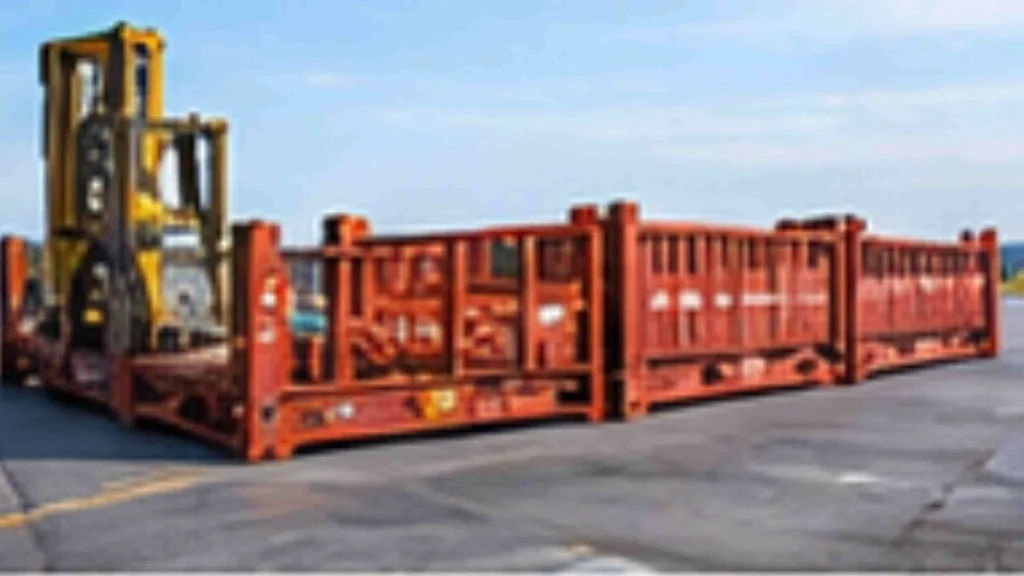
Flat rack container dimensions vary more than any other box type: a 40ft flat rack’s payload ranges from 38,800 kg to 49,100 kg depending on the carrier and design, and inside length runs from about 11,650 to 11,890 mm. Open tops are closer to dry boxes, roughly 5,900 × 2,350 × 2,340 mm for a 20ft, but load through the roof. Use the calculator below to check volume and weight first, then compare your cargo’s dimensions with the tables here.
Which container do I need?
Runs in your browser; nothing you enter is sent anywhere. Carrier figures differ, so confirm the final numbers with your forwarder. Whole shipment: all-in-one freight calculator →
When to use an open top or a flat rack
- Open top: a box with walls and a removable roof. It suits cargo that is too tall to go through the doors or must be lifted in by crane from above, such as machinery or heavy crates.
- Flat rack: a floor with end walls and no side walls or roof. It suits cargo that is too wide, too tall or too heavy for a closed box.
Cargo that extends beyond the container’s normal dimensions is called out-of-gauge (OOG). Over-height, over-width and over-length cargo usually needs special arrangements with the carrier, so raise it at booking stage.
Open top container dimensions
| Carrier | 20ft OT inside L × W × H (mm) | 20ft OT payload (kg) | 40ft OT inside L × W × H (mm) | 40ft OT payload (kg) |
|---|---|---|---|---|
| Hapag-Lloyd | 5,895 × 2,350 × 2,340 | 30,050 | 12,029 × 2,350 × 2,344 | 28,450 |
| CMA CGM | 5,898 × 2,352 × 2,348 | 28,280 | 12,032 × 2,352 × 2,348 | 26,600 |
| ONE | 5,898 × 2,350 × 2,348 | 28,240 | 12,022 × 2,350 × 2,348 | 26,600 |
The roof opening is smaller than the floor. Hapag-Lloyd lists a roof opening of 5,338 × 2,230 mm on its 20ft open top and 11,552 × 2,230 mm on its 40ft. Door openings are about 2,338–2,340 mm wide and 2,276–2,280 mm high. Volumes are about 32–32.5 m³ (20ft) and 66–66.8 m³ (40ft). Hapag-Lloyd rates its 20ft open top at 32,500 kg gross, while CMA CGM and ONE list 30,480 kg, which explains most of the payload gap.
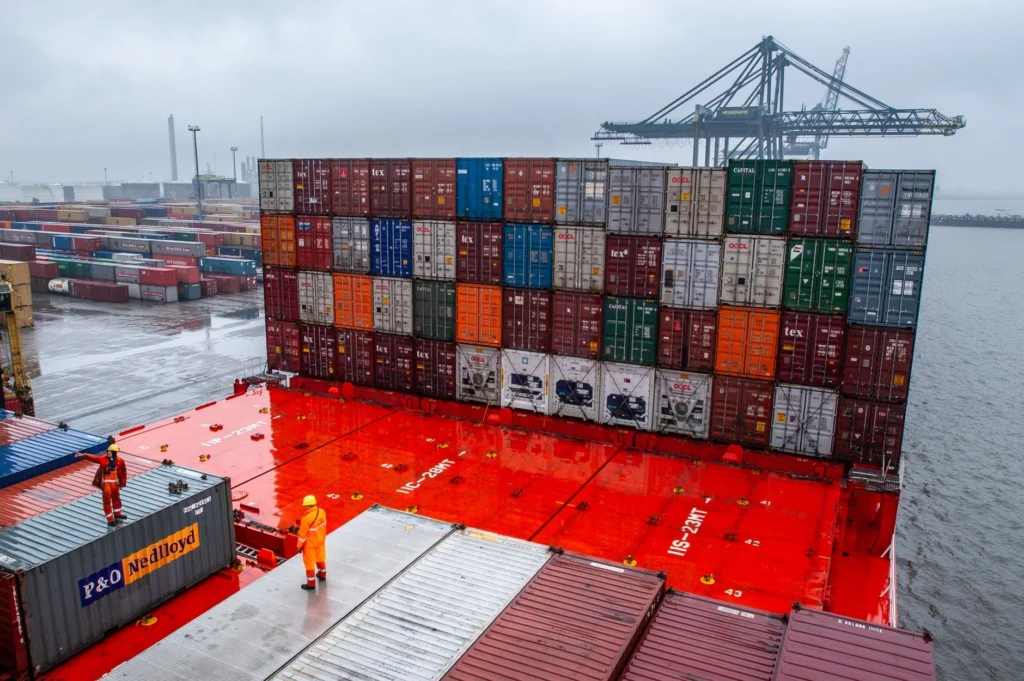
Flat rack container dimensions
| Box | Inside L × W × H (mm) | Tare (kg) | Max gross (kg) | Payload (kg) |
|---|---|---|---|---|
| Hapag-Lloyd 20ft | 5,638 × 2,438 floor (2,194 min) × 2,233 | 2,900 | 45,000 | 42,100 |
| CMA CGM 20ft | 5,718 (ends folded) × 2,224 × 2,213 | 2,750 | 34,000 | 31,250 |
| ONE 20ft | 5,568 × 2,194 × 2,213 | 3,100 | 38,100 | 35,000 |
| Hapag-Lloyd 40ft high cube | 11,652 × 2,347 floor (2,245 min) × 2,265 | 5,900 | 55,000 | 49,100 |
| CMA CGM 40ft | 11,888 (ends folded) × 2,227 × 1,959 | 5,100 | 52,500 | 47,400 |
| ONE 40ft | 11,652 × 2,208 × 1,955 | 6,200 | 45,000 | 38,800 |
These are different designs, including collapsible and fixed-end racks and high-cube versions, which is why the numbers differ so much. Hapag-Lloyd also lists a floor height of 648 mm for its 40ft flat rack high cube, which matters when you work out the total height of the loaded unit. Always get the exact flat rack container dimensions specification for the unit you will be given. More reference figures are on the container and pallet specifications page.
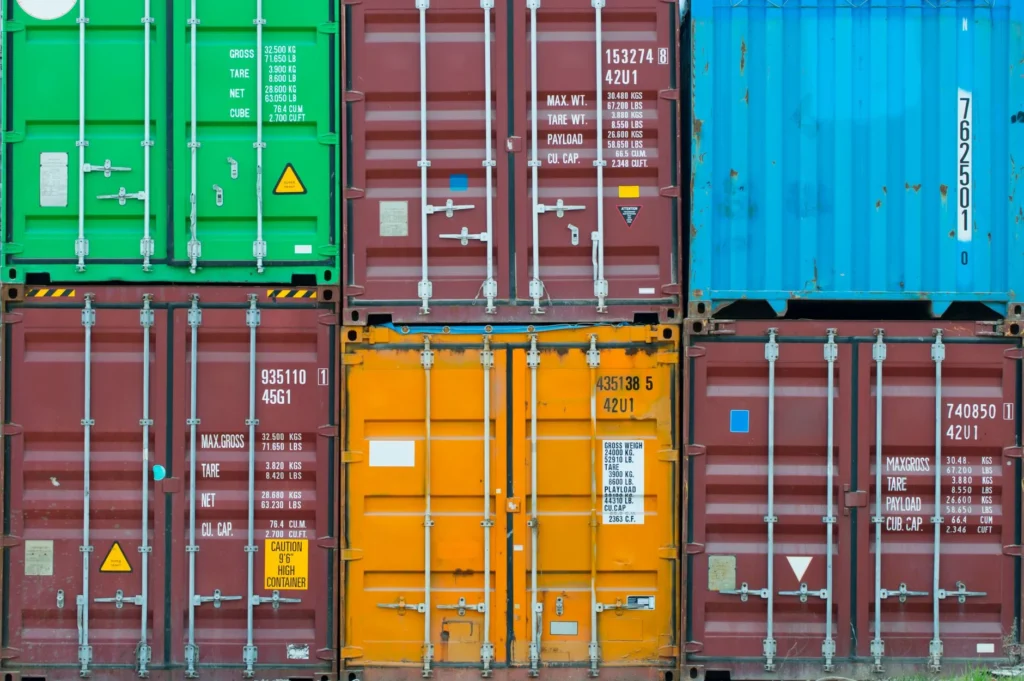
Worked example 1: a tall machine in a 20ft open top
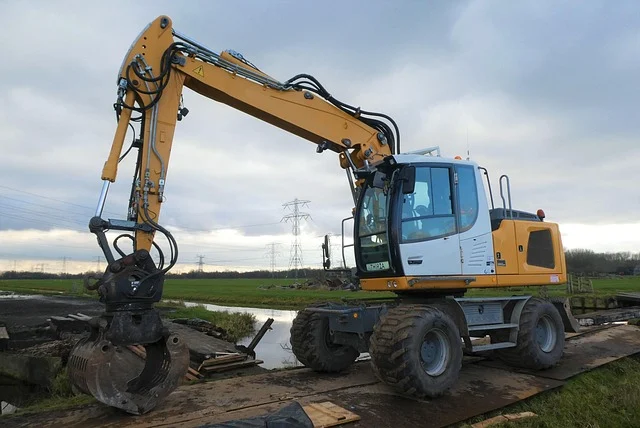
Say you ship a machine measuring 5,000 × 2,200 × 2,600 mm (196.9 × 86.6 × 102.4 in), weighing 9,000 kg. Using Hapag-Lloyd’s 20ft open top:

- Through the doors? Door height 2,280 mm is less than 2,600 mm, so no.
- Through the roof: length 5,000 ≤ 5,338 mm (338 mm spare); width 2,200 ≤ 2,230 mm (30 mm spare). It fits, but only just across the width.
- Height: 2,600 − 2,340 = 260 mm above the inside height, so the machine is over-height.
- Weight: 9,000 kg is well within the 30,050 kg payload.
Result: an open top works, with the cargo treated as over-height. With only 30 mm of width clearance, for flat rack container dimensions through the roof opening, measure the machine at its widest point, including any brackets; see how to measure cartons and pallets.
Worked example 2: a heavy unit on a flat rack
Say you ship a single unit of 38,000 kg, measuring 5,200 × 2,150 × 2,400 mm, with 500 kg of lashing and blocking.
- Total load: 38,000 + 500 = 38,500 kg
- 20ft flat racks: CMA CGM 31,250 kg and ONE 35,000 kg are too low; Hapag-Lloyd’s 42,100 kg works, with 3,600 kg spare
- Fit on the 20ft Hapag-Lloyd rack: length 5,200 ≤ 5,638 mm; width 2,150 ≤ the 2,194 mm minimum; height 2,400 mm is above the listed 2,233 mm, so it is over-height
- 40ft alternatives: ONE’s 38,800 kg payload leaves only 38,800 − 38,500 = 300 kg spare; CMA CGM (47,400 kg) and Hapag-Lloyd (49,100 kg) leave more margin
Result: the right flat rack depends on the carrier. The same cargo is impossible on one line’s 20ft rack and possible on another’s. Securing material always counts toward the payload, and the gross mass you declare must include it; see verified gross mass.
Practical tips for OOG cargo
- Send exact dimensions, weight and a drawing showing the center of gravity and lifting points to the carrier before booking.
- Ask whether a heavy, compact item needs extra load spreading on the floor.
- Plan lashing and blocking as part of the load, and count its weight; the container loading plan guide covers securing.
- Check the payload of the exact box: 20ft flat racks range from 31,250 to 42,100 kg in the table above.
- Check the road leg too, because a heavy flat rack can exceed road limits; see container weight limits.
- Review your cargo insurance, since open and exposed cargo carries different risks from goods inside a closed box.
If your cargo fits a standard box after all, compare options in 20ft vs 40ft container.
FAQ
What are the dimensions of a 40ft flat rack?
It depends on the design: for flat rack container dimensions about 11,652–11,888 mm long and 2,208–2,347 mm wide inside, with heights from about 1,955 to 2,265 mm, based on Hapag-Lloyd, CMA CGM and ONE.
How much weight can a flat rack carry?
Published 40ft flat rack payloads range from 38,800 kg (ONE) to 49,100 kg (Hapag-Lloyd high cube). 20ft flat racks range from 31,250 kg to 42,100 kg.
What is the difference between an open top and a flat rack?
An open top has side and end walls and a removable roof, so cargo is loaded from above. A flat rack has no side walls or roof, so it suits wide as well as tall cargo.
How big is the roof opening on an open top?
Hapag-Lloyd lists 5,338 × 2,230 mm for its 20ft open top and 11,552 × 2,230 mm for its 40ft, smaller than the inside floor.
What does out-of-gauge mean?
Out-of-gauge cargo extends beyond a container’s normal dimensions, such as over-height or over-width. It usually needs special arrangements with the carrier.
Related guides
- LCL vs FCL: When Does a Full Container Become Cheaper?
- Shipping Container Dimensions: 20ft, 40ft, 40ft High Cube and 45ft
- LCL or FCL for Amazon FBA Inventory?
- Reefer Container Dimensions and Capacity (20ft and 40ft High Cube)
Sources and further reading
- Hapag-Lloyd: 20′ Open Top Container: open-top dimensions and roof opening.
- Hapag-Lloyd: 40′ Flat Rack High Cube: flat rack dimensions and payload.
- Ocean Network Express: Dry Containers: dimensions, tare and payload.
- CMA CGM: Container Types and Sizes: dimensions and payloads for every box type.