
 By
A 40ft container has about 2.04 times the volume of a 20ft. For example, it has 67.7 m³ versus 33.2 m³ at Hapag-Lloyd. However, it has almost the same payload. This is 28,750 kg versus 28,130 kg. Therefore, your choice depends on density. Bulky, light cargo belongs in a 40ft. Conversely, heavy, dense cargo usually fits a 20ft just as well. Use the calculator below. It will help you find the smallest container for your volume and weight.
Which container do I need?
Runs in your browser; nothing you enter is sent anywhere. Carrier figures differ, so confirm the final numbers with your forwarder. Whole shipment: all-in-one freight calculator →
20ft vs 40ft at a glance
These figures come from Hapag-Lloyd. They are for standard dry boxes. We also included a forwarder rule of thumb for realistic loading. Other lines may differ slightly. See shipping container dimensions for more information.
| Measure | 20ft standard | 40ft standard | 40ft high cube |
|---|---|---|---|
| Inside length (mm) | 5,900 | 12,032 | 12,032 |
| Inside height (mm) | 2,395 | 2,395 | 2,700 |
| Volume (m³) | 33.2 | 67.7 | 76.3 |
| Typical real load (m³) | 25–28 | 55–60 | 65–68 |
| Tare (kg) | 2,350 | 3,750 | 3,900 |
| Max gross (kg) | 30,480 | 32,500 | 32,500 |
| Payload (kg) | 28,130 | 28,750 | 28,600 |
The volume ratio is 67.7 ÷ 33.2 = 2.04. The payload ratio is 28,750 ÷ 28,130 = 1.02. Doubling the box roughly doubles the space but adds only about 620 kg of payload.
The density test
Divide each box’s payload by its realistic volume. That gives the cargo density at which the box “fills up” on weight and volume at the same time.
- 20ft: 28,130 ÷ 28 = 1,005 kg/m³; 28,130 ÷ 25 = 1,125 kg/m³
- 40ft: 28,750 ÷ 60 = 479 kg/m³; 28,750 ÷ 55 = 523 kg/m³
- 40ft high cube: 28,600 ÷ 68 = 421 kg/m³; 28,600 ÷ 65 = 440 kg/m³
Your cargo density is total weight ÷ total CBM. If it is well above about 500 kg/m³, a 40ft will run out of weight. This happens long before it runs out of space. In this case, the extra length does nothing for you. The shipping density guide explains density. It gives values in kg/m³ and lb/ft³.
Decision table by CBM and weight
This table uses the rule-of-thumb loadable volumes. It also uses Hapag-Lloyd payloads. Therefore, it is a starting point. It is not a loading plan.
| Shipment volume | Shipment weight | Usual first choice |
|---|---|---|
| Up to about 25 m³ | Up to about 28 t | 20ft |
| About 25–55 m³ | Up to about 28 t | 40ft standard |
| About 55–65 m³ | Up to about 28 t | 40ft high cube |
| Any volume | Over about 28 t | Two containers (often 2 × 20ft) |
| Under about 15 m³ | Any | Compare LCL against a 20ft |
For small volumes, see LCL vs FCL to compare consolidated shipping with a full box.
Worked examples
Example 1: furniture, 34 m³ and 6,500 kg
- Density: 6,500 ÷ 34 = 191 kg/m³, which is light
- 34 m³ is above the 20ft realistic range of 25–28 m³
- A 40ft standard (55–60 m³ realistic) takes it with room to spare; 6,500 kg is far below 28,750 kg
Result: 40ft. A 20ft would need 34 ÷ 33.2 = 1.02 times its full theoretical volume, which is impossible.
Example 2: ceramic tiles, 16 m³ and 25,000 kg
- Density: 25,000 ÷ 16 = 1,563 kg/m³, which is very dense
- 20ft payload 28,130 kg: 25,000 kg fits with 3,130 kg spare for pallets and dunnage
- A 40ft gives only 620 kg more payload and more than twice the empty floor
Result: 20ft. The 40ft would carry the same tiles with about 67.7 − 16 = 51.7 m³ of empty air.
Example 3: machine parts, 40 m³ and 41,000 kg
- Volume alone points to a 40ft
- But 41,000 kg is over any single 40ft payload (Hapag-Lloyd 28,750 kg)
- Split into two 20ft boxes: 20 m³ and 20,500 kg each, both within 25–28 m³ and 28,130 kg
Result: 2 × 20ft. Spreading weight across two boxes is the usual answer when cargo is both bulky and heavy. Check container weight limits for the payload of the exact boxes offered.
Comparing the cost per cubic meter
Carriers price each container type separately. So, the only reliable way to compare is per usable cubic meter. You must use your own quotes. Here is an example with made-up rates. You would replace these rates with your own.
- 20ft quote of 1,800 ÷ 26 m³ realistic = 69.2 per m³
- 40ft quote of 2,600 ÷ 58 m³ realistic = 44.8 per m³
If your cargo actually fills the 40ft, the bigger box can cost less per cubic meter. However, if you only have 26 m³, the 20ft is the one to price. This is because you pay for the box, not the cargo inside it. Include local charges, trucking, and port fees in both quotes. Do this before you compare them.
Road limits and inland moves
The ocean payload is not the only limit. The truck leg often decides what is legal.
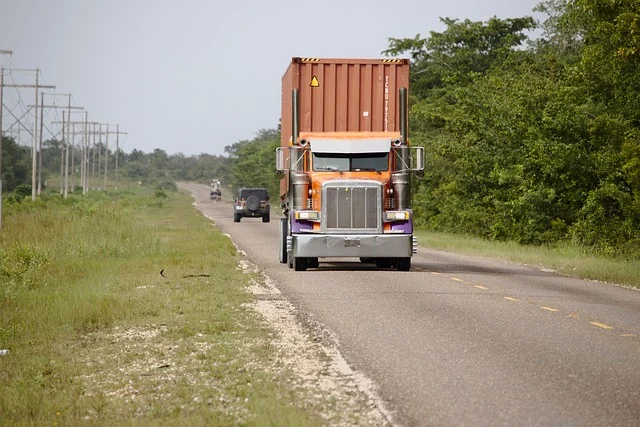
- US: the federal Interstate gross vehicle weight limit is 80,000 lb, with 20,000 lb on a single axle and 34,000 lb on a tandem axle (FHWA). A 20ft at its 30,480 kg maximum gross weighs 30,480 × 2.20462 = 67,197 lb before the tractor and chassis are added. Ask the trucking company what its equipment weighs. See US truck weight limits.
- EU: Directive 96/53/EC sets a general maximum of 40 t, with 44 t allowed for intermodal transport carrying 40ft containers. See EU truck and trailer sizes.
A heavy 20ft can be legal at sea and still need special arrangements on the road. Also check that your warehouse can receive the length of trailer that a 40ft needs.
Common mistakes
- You might choose by volume alone. Then you discover the cargo is overweight for one box.
- Assuming a 40ft can carry twice the weight of a 20ft. It cannot.
- Planning to the theoretical 33.2 or 67.7 m³ instead of a realistic load. See broken stowage.
- Forgetting that pallets, dunnage and lashing count toward payload.
- Comparing a 20ft and a 40ft quote without converting both to cost per usable m³.
FAQ
Is a 40ft container twice the size of a 20ft?
In volume, nearly: about 67.7 m³ vs 33.2 m³ at Hapag-Lloyd, a ratio of 2.04. In payload, no: about 28,750 kg vs 28,130 kg.
Which container is better for heavy cargo?
Usually, a 20ft container is better. Both boxes carry roughly 28 tons. So, dense cargo fills a 20ft’s weight limit. This happens without wasting the extra space of a 40ft container.
How many pallets fit in a 20ft vs 40ft?
iContainers gives 11 EUR pallets on one floor level in a 20ft and 24–25 in a 40ft, single-tier. Larger pallets such as 1,200 × 1,000 mm fit fewer.
When should I pick a 40ft high cube instead of a 40ft?
When your load is light and volume-limited, and your cartons or pallets can use the extra 300 mm of height. Payload is not higher.
Can a fully loaded 20ft go on any truck?
This is not always true. A 20ft container weighs about 67,197 lb gross. This is 30,480 kg before the tractor and chassis. So, you must check road limits. Also, verify the trucker’s equipment weight.
Related guides
- Open Top and Flat Rack Containers: Sizes and When to Use Them
- How Many Pallets Fit in a 20ft and 40ft Container?
- How Many Cartons Fit in a 20ft or 40ft Container?
- Reefer Container Dimensions and Capacity (20ft and 40ft High Cube)
Sources and further reading
- Hapag-Lloyd: 20′ Standard Container: inside dimensions, door, volume, tare and payload.
- Hapag-Lloyd: 40′ Standard Container: inside dimensions, volume and payload.
- CMA CGM: Container Types and Sizes: dimensions and payloads for every box type.